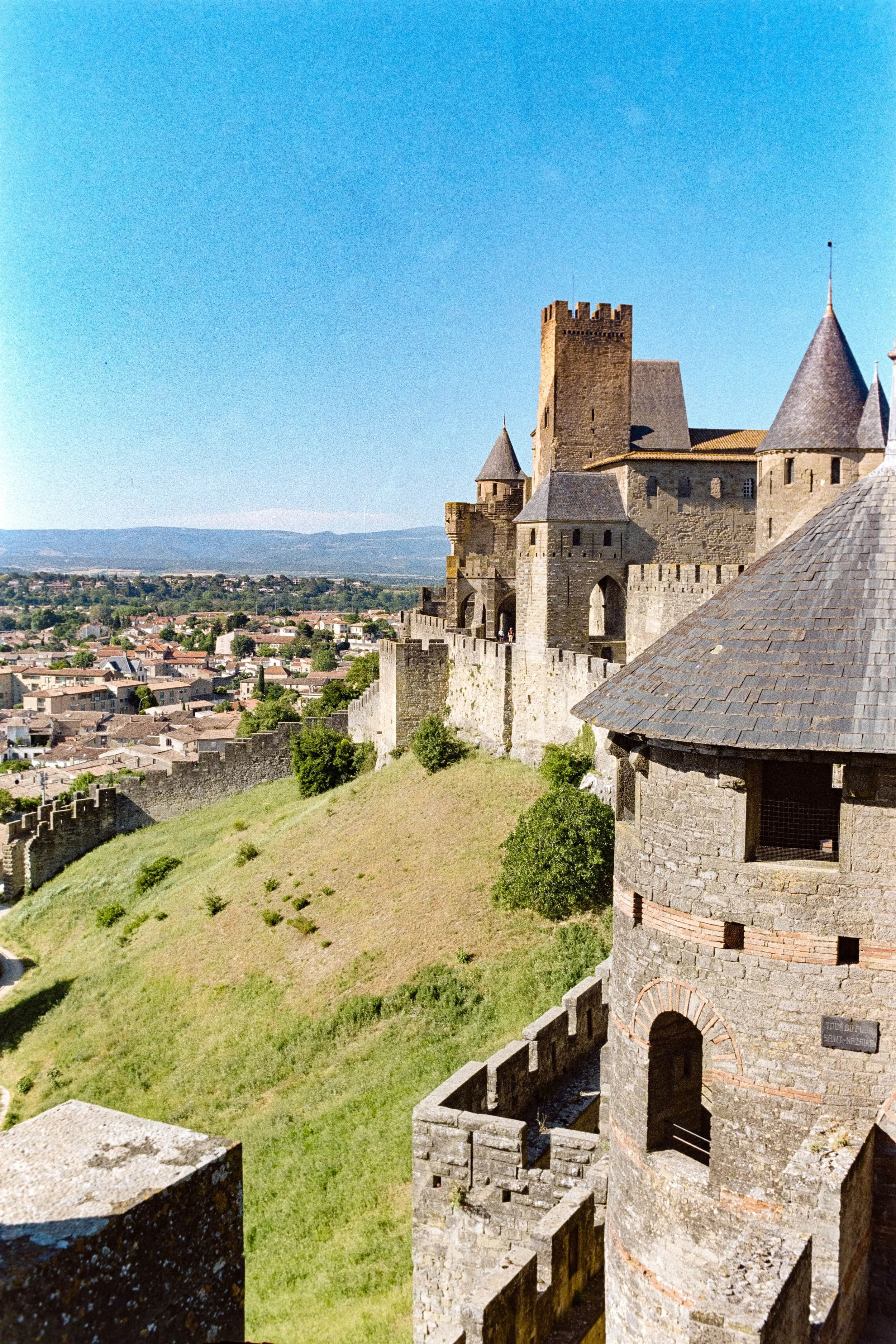
Carcassonne Has Two Towns. You Want the Other One.
Published September 2026 · Elizabeth Franklin-Best is an attorney who owns a home in Carcassonne's Bastide Saint-Louis and splits her year between South Carolina and the Aude.
Carcassonne's Bastide Saint-Louis is the living, working lower town across the river from the famous medieval citadel. Founded by the French crown in the thirteenth century on a grid around a market square, it is where the cafés, markets, museums, and canal actually are, and where an American looking for a home in the south of France should be looking.
Almost everyone who visits Carcassonne sees one town. There are two.
The one on the postcards is La Cité, the walled citadel on the hill, with its fifty-odd towers and its Disney-before-Disney skyline. Two million people a year walk its ramparts. Most of them never cross the river. That is the mistake, and it is a lucky one, because it leaves the better town to the people who live there.
The better town is the Bastide Saint-Louis. It sits on the flat left bank of the Aude, a ten-minute walk downhill and across a fourteenth-century stone bridge. It has a square with a fountain, a market three mornings a week, a fine-arts museum that costs nothing, a canal with boats on it, and streets laid out so sensibly that you will never once be lost. I bought a home there. I would like to tell you why.
What is a bastide, exactly?
A bastide is a planned town. That sounds unremarkable until you remember that most European towns are not planned at all; they are accretions, a thousand years of people building wherever the last person stopped. Bastides are different. In the thirteenth and fourteenth centuries, the kings of France and England, the counts of Toulouse, and a great many lesser lords founded several hundred new settlements across the southwest of France, from the Atlantic to the Mediterranean. Each was drawn on paper before it was built on the ground.
The recipe was consistent. Lay out a grid of straight streets. Leave a square at the center for the market. Put the church a block off the square, not on it, because commerce came first. Then offer settlers a charter: a plot of land, a set of written liberties, and relief from the worst of the feudal obligations they had known elsewhere. People came. The bastides were, in the most literal sense, real-estate developments with good terms.
Most of them are villages today, and lovely ones. Carcassonne's is unusual. It was built for a whole displaced population and it grew into a city, the seat of the département and the commercial capital of the Aude. It kept the grid and the square, and it added everything a city needs.
Why does Carcassonne have a bastide at all?
Because the king was angry.
In the 1240s the people of the Cité backed the wrong side in the last gasp of the Cathar wars. When the crown prevailed, Louis IX, later Saint Louis, expelled them from the citadel and, after a few years' penance, allowed them to build again on the other bank of the river, under his name and on his plan. The new town was walled, gated, and laid out in the checkerboard the bastide builders favored. It was burned by the Black Prince in the fourteenth century and rebuilt. The cloth merchants made it rich. The Canal du Midi arrived in the eighteenth century and made it richer. The ramparts came down and became tree-lined boulevards, which is why the Bastide today has a green ring around it where the walls used to be.
So the Bastide is not the Cité's suburb. It is the Cité's replacement, and it has been the real Carcassonne for seven hundred years.
What is there to love in the Bastide Saint-Louis?
Start where everyone starts, at Place Carnot. It is the square the whole town was drawn around, ringed by cafés, with a fountain of Neptune in the red marble that comes from a village up the road in the Minervois. On Tuesday, Thursday, and Saturday mornings the market fills it: cheese, olives, the first cherries in May, the last figs in October, and a great deal of conversation. You will learn more French at that market in a month than in a year of apps.
From the square, the grid does the rest. Rue de Verdun and the streets around it are where the shops are. Walk any direction and you will pass the townhouses the cloth merchants built, with their carved doorways and colorful façades, many of them freshly restored in a campaign the city has been running for a decade. Keep walking and you reach the boulevards, and the little gates in the mind's eye where the real gates once stood. One survives, the Portail des Jacobins, with a fragment of the old wall beside it.
The Bastide has two churches worth your time. Saint-Michel, a fourteenth-century church promoted to cathedral in the nineteenth, was the first building Viollet-le-Duc restored in Carcassonne before he turned his attention to the citadel. Saint-Vincent, a few streets away, has a bell tower you can climb for a view of the whole grid, the river, and the Cité on its hill, which is the best way to understand the two-town arrangement in a single glance.
Then there is the museum. The Musée des Beaux-Arts sits opposite Square Gambetta in a handsome old courthouse, and it is free. Brueghel, Ingres, Corot, Courbet, and a good deal of regional painting, and on a weekday afternoon you may have it to yourself. A few blocks away, the Maison des Mémoires keeps the rooms of Joë Bousquet, the surrealist poet who was paralyzed in the First World War and spent the rest of his life in a shuttered bedroom in this town, receiving the great writers of Europe. It is one of the strangest and most moving small museums in France.
Square Gambetta itself was recently remade, with roses, a reflecting pool, and a carousel, and it is where the town takes its lunch in the sun. On the northern edge of the grid, by the railway station, the Canal du Midi slides past the Port, where you can watch the boats work the lock or step onto one yourself. The towpath runs for miles in either direction under the plane trees. I have walked it in every season and never once wished I were somewhere else.
Is the Bastide a place to live, or a place to visit?
It is a place to live. That is the whole point.
The Cité is a monument. It is magnificent, and it is also a place where almost no one sleeps, where the shops sell plastic swords, and where the last tour bus leaves at six. The Bastide is where the pharmacist knows your name. It has a train station with direct service to Toulouse and to Narbonne, and from there to Paris, Barcelona, and Montpellier. It has the market, the boulangeries, the doctors, the hardware store, the bookshops, and the kind of café where the same four men have had the same table since the Mitterrand years.
For an American, that combination is rare. Most of the France we fall in love with on holiday is either a village too small to live in year-round or a city too large and too expensive to feel like ours. The Bastide is the size of a neighborhood, with the amenities of a city, inside a town that the rest of the world walks past on its way to the castle. I have come to think of that as the Bastide's great secret. Everyone looks up. Nobody looks across the river.
Frequently asked questions
Is the Bastide Saint-Louis the same as the "lower town"? Yes. The French call it the Ville Basse. The Cité on the hill is the Ville Haute. When someone in Carcassonne says "en ville," they mean the Bastide.
How far is the Bastide from the Cité? A short walk. Cross the pedestrian Pont Vieux and climb the hill, and you are inside the citadel in about a quarter of an hour. Living in the Bastide means having one of the great monuments of Europe as your evening stroll.
Is Carcassonne a good base for exploring the south of France? It is an excellent one. The Mediterranean beaches, the Pyrenees, the wine villages of the Corbières and the Minervois, and Toulouse are each within about an hour, and the canal runs through the middle of town.