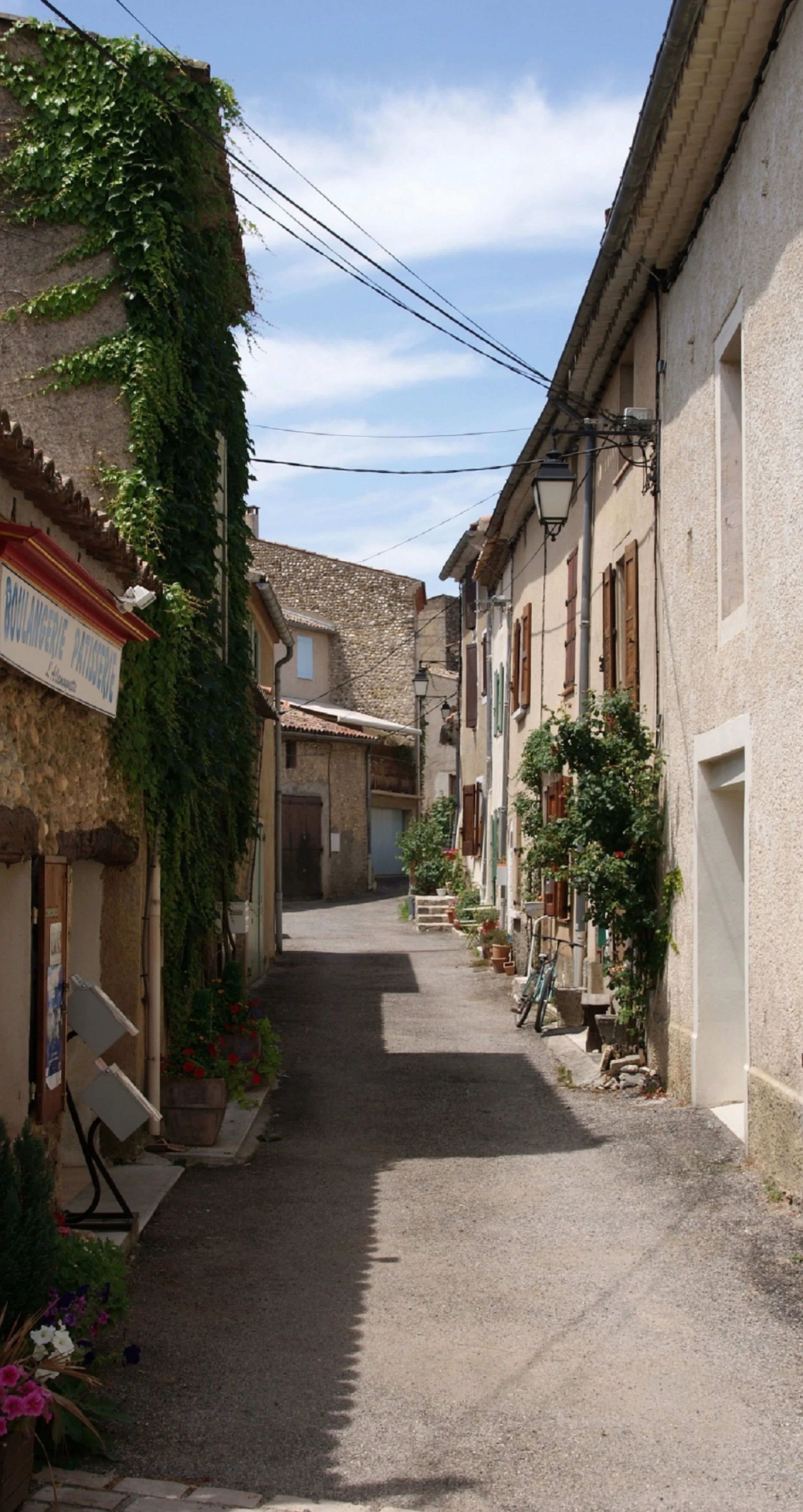
The Village that Ran Out of Cloth but Reinvented Itself with Books
Montolieu sits roughly twenty minutes northwest of Carcassonne by car. There are about eight hundred lucky souls who live there, and fifteen bookshops serve them. The petite village did not begin as a literary destination. It began as a cloth town, and it became a book town only after the cloth industry failed and a brilliant bookbinder launched an idea.
The village was first built on wool, not on words
Long before anyone shelved a book there, Montolieu was known for cloth-making. The Ramel family set up workshops along the Dure in the sixteenth century, drawing on the one thing the village had in abundance: fast water falling out of the Montagne Noire. The operation grew into a Royal Manufactory. By 1812 it ran a hundred and thirty-seven looms and employed two hundred and fifty-seven workers, and it stood first among the dozen royal manufactories in the region. Cloth from this small French village even reached China.
Then it ended. The Revolution unsettled the trade, an English blockade during the Napoleonic wars closed the export routes, the equipment aged past repair, and in 1818 the manufactory produced its last bolt.
The village kept trying for another hundred and fifty years
Despite those hardships, the village continued to strive to exist (and the world is better for its efforts!)
In 1845, the Cazaban brothers bought the land and rebuilt a textile factory with mechanical looms. From 1887, Paul Cavaillès made woolen goods and military cloth there — blankets for soldiers, and blankets for their horses. In 1939, the buildings held four hundred Spanish Republicans who had crossed the Pyrenees in the Retirada, and for a few months a failing textile works served as a refuge. A Belgian industrialist bought the site in 1940 and kept it running until 1968.
In that year, the looms went quiet, and the census counted 896 residents. Over the next four decades the population fell to 760. Regrettably, this is the ordinary arithmetic of rural France, and it is what many villages in the Aude have to show for the twentieth century.
One bookbinder decided the village needed a reason, not an industry
M. Michel Braibant bound books in Carcassonne. In 1990 he looked at Montolieu — the empty workshops, the falling census, the water still running — and proposed something that must have sounded absurd. He had seen what Hay-on-Wye had done in Wales, where a small border town rebuilt itself around secondhand books, and he thought the Aude could do the same.
His ambition, though, went past commerce. M. Braibant wanted a European conservatory of the arts and crafts of the book: binding, printing, papermaking, typography, the whole vanishing apparatus. He opened the Musée des Arts et Métiers du Livre in 1991 in Montolieu, stocked from his own collection and from what people gave him.
The booksellers came after the museum, not before it. M. Braibant did not build a shopping street and hope for meaning; he built a reason and let the commerce assemble around it.
What the village looks like now
Fifteen bookshops, most dealing in secondhand and antiquarian stock. There are also painters, sculptors and photographers with working studios who have set up in the village. There is also a museum of art brut housing the Cérès Franco collection located in the town. Something on the order of fifty thousand visitors a year now visit, and a couple of thousand schoolchildren pass through the workshops yearly.
And the census stopped falling. The 2023 count came in at 829 — still under the 1968 figure, but no longer sliding toward zero, which is more than most villages of its size can say.
Montolieu is still a small, quiet village and it’s closed for a good part of the winter. Nobody there is rich. But the village exists on its own terms, and it exists because one person understood something that turns out to be true in a lot of places: a village that loses its industry has not necessarily lost its future. It has lost its reason. Those are different problems, and only one of them requires a factory.
To me, Montolieu symbolizes something about this part of France that I am particularly drawn to—resilience and creativity. Ever since I started exploring this area of France, this little gem has been on my to-do list. I have to confess, I haven’t actually made it here yet—now that we have our little pied-a-terre in Carcassonne, I’m still working out the logistics of taking buses or renting cars and travelling into these small communities. But I wanted to share because I’m so excited about spending time (and money!) in community that clearly is welcoming those of us who love books and the arts!