The Other Language of Southern France
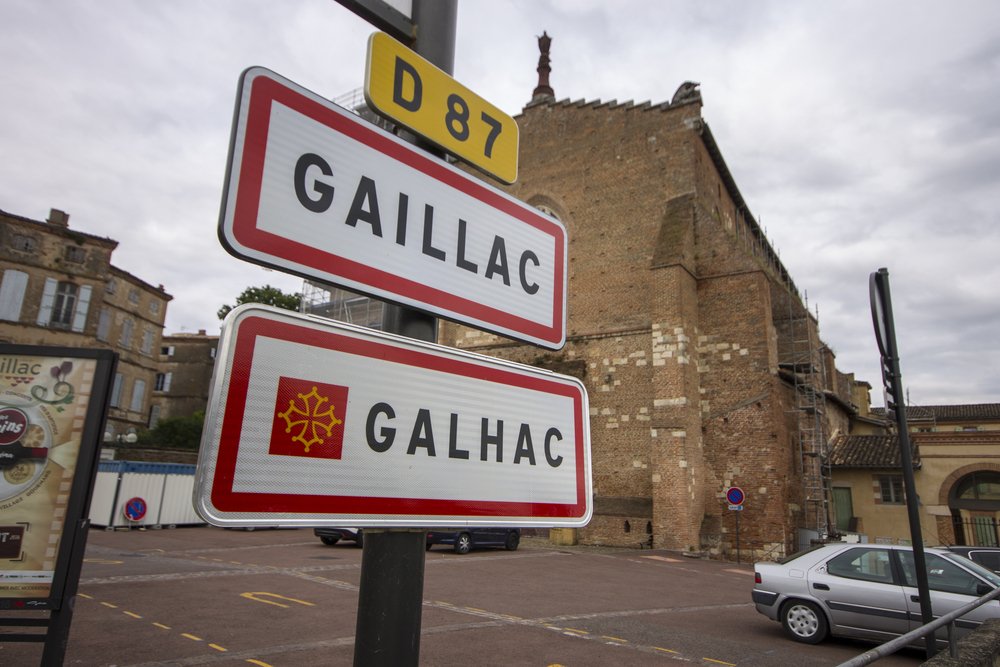
If you drive through a village in Occitanie and look at the road signs, you'll often see two names. One is the French name you'd expect. The other is something else — older, stranger, closer to Spanish or Italian than to French. That other language is Occitan, and it was here first.
I want to write about it briefly, because it's the kind of thing an American moving to this part of France should know something about — not to speak it, necessarily, but to understand what they're seeing when they see it.
What Occitan is
Occitan is a Romance language, like French, Spanish, Italian, and Catalan. All of them descended from the Latin the Romans left behind when the empire receded. But Latin didn't decay uniformly. It broke apart along regional lines, and by the early Middle Ages there were two clearly different Romance languages taking shape in what is now France — one in the north, one in the south, divided roughly by the Loire.
The medieval Italian poet Dante was the first to write down the distinction we still use. In De vulgari eloquentia, written around 1305, he grouped the Romance languages by how they said the word yes. In the south of France, people said òc. In the north, they said oïl. In Italy, sì. Hence langue d'oc (the language of òc), langue d'oïl (which eventually became modern French — oïl softened into oui), and langue de sì (Wiktionary, Language Closet). All three words trace back to the Latin hoc, meaning "this." Southerners said hoc and dropped the h. Northerners built it up into hoc ille — "this is it" — and eventually smoothed it down to oui.wiktionary+1
That's the whole reason this region is called Occitanie. It's the land where people said òc.
How it's different from French
To an American ear that has spent any time with Spanish, Occitan sounds more familiar than French does. It's less nasal. It pronounces the final consonants French drops. Its vowels are clearer and brighter. In some dialects, the r is trilled rather than the guttural French r.
The grammar is closer to Latin than French is. Occitan keeps six distinct verb endings; French has collapsed several of them into the same sound. Occitan speakers can often omit the subject pronoun — canti means "I sing," without needing je — the same way Italian and Spanish speakers can.howtolearnlanguages
There's a good reason for the family resemblance. Catalan, spoken across the border in Spain, was considered a dialect of Occitan until the late nineteenth century, and it remains Occitan's closest living relative. If you're standing on a mountain in the Pyrenees, the òc language flows south into Catalonia without a natural border. The border was drawn by politics, not by speech.wikipedia
Why it matters, historically
In the twelfth and thirteenth centuries, Occitan was the language of the troubadours — the poet-musicians whose lyric verse essentially invented the European tradition of romantic love as a literary subject. Occitan was the first literary language of modern Europe, prestigious across the courts of Aquitaine, Provence, and beyond. Eleanor of Aquitaine spoke it. So did her son, Richard the Lionheart of England — Occitan was his first and preferred language.midi-france
Then the Albigensian Crusade happened in the thirteenth century. Northern French forces, with the blessing of Rome, moved south and effectively ended the political independence of the Occitan-speaking lands. From that point forward, the language began a long decline. The 1539 Ordinance of Villers-Cotterêts required all administrative and legal acts in France to be written in French. By the Revolution, official policy actively suppressed regional languages as obstacles to national unity. By the mid-twentieth century, most children in southern France were being punished at school for speaking Occitan at home.
Today, all six dialects of Occitan are classified as endangered by UNESCO, and four of them — including Provençal — as severely endangered. Children in the south don't grow up speaking it. Few study it in school.blog.duolingo
What you'll actually see
You'll see it on road signs, mostly. Since a 1980s decentralization law, communes in southern France have been allowed to add regional-language names to their bilingual town signs, and many have. So you'll drive into Toulouse and see Tolosa. Into Carcassonne and see Carcassona. Into Nîmes and see Nimes (same spelling) but with the Occitan pronunciation still lingering in the way local people say it.
You'll see it on the fronts of certain shops and maisons de la culture. You'll see it in the names of wines — pays d'oc is one of the largest wine-producing designations in France. You'll see it in the name of the beauty brand L'Occitane en Provence, which is French for "the Occitan woman in Provence." And in older village bakeries and cafés, you'll occasionally hear it — usually spoken by someone over seventy, usually to another person over seventy, usually at a volume meant to keep it between them.
Why I bring this up
Because it's easy to arrive in this part of France and assume that what you're seeing is simply France, in the way that arriving in Kansas is simply America. But Occitanie was a distinct cultural and linguistic world for a thousand years before it was folded into France, and a great deal of what makes the food, the architecture, the music, and the temperament of the south feel different is that it is different. The Occitan language is the surviving evidence of that difference. The road signs are the trace of it.
You don't need to learn the language. Almost no one who moves here does. But when you see the second name on the sign, it's worth knowing what it is — a reminder that you've moved not to a homogenous France but to a specific place, with a specific past, that is still quietly insisting on itself.