What if changing your life isn't always about changing yourself?
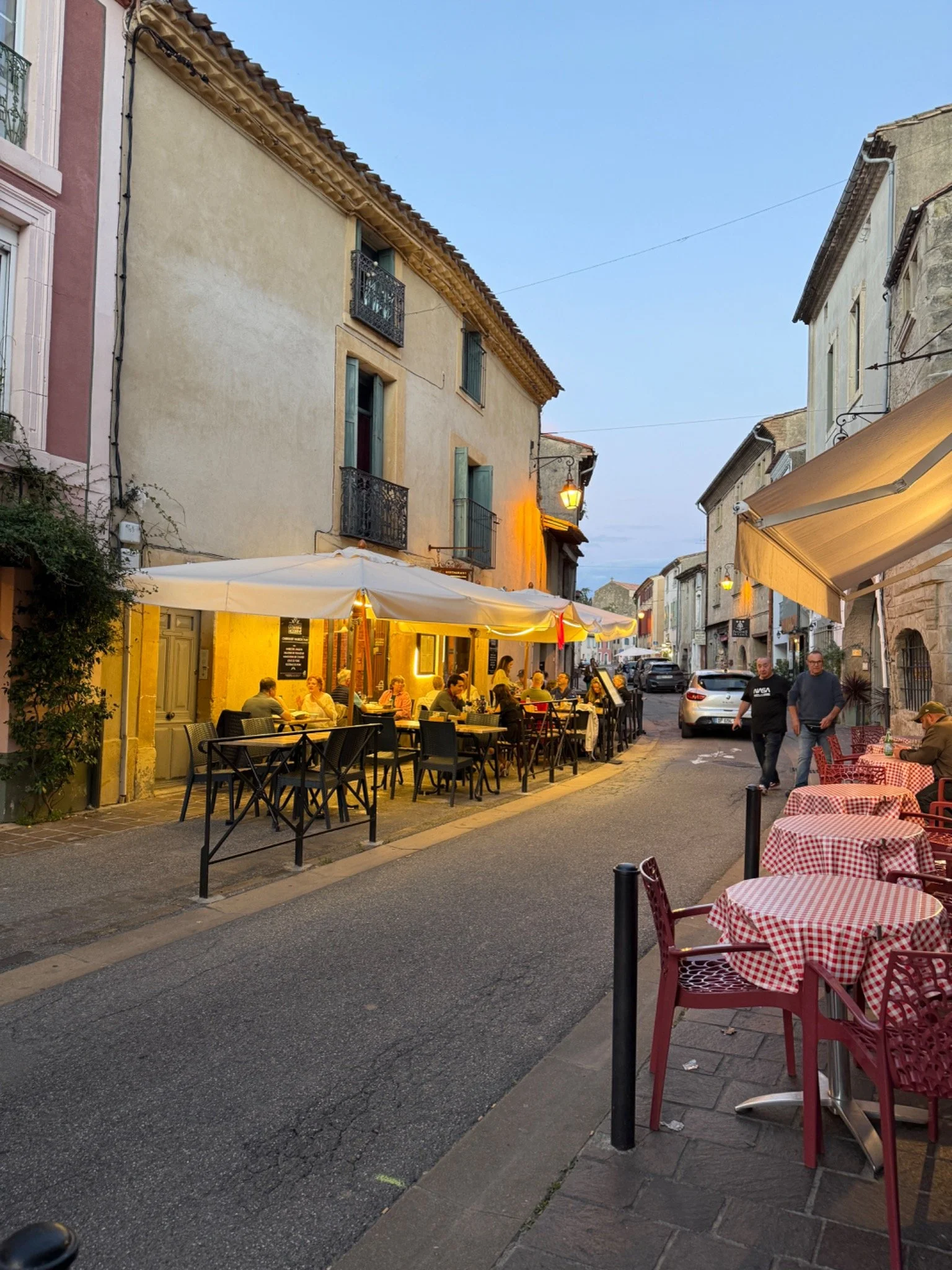
Carcassonne: an environment arranged around everyday human activity.
When I'm in Carcassonne, I make countless small decisions about how to spend my days. Which café should I visit this morning? Where should I have lunch? Should I spend the afternoon exploring the medieval Cité, wandering through the Bastide Saint-Louis, or simply sitting somewhere with a book?
But I've begun to appreciate that some of the most consequential aspects of my days here aren't the result of decisions I make at all.
They're the result of the environment in which I find myself.
And I've been thinking about what that might tell us about the way we organize our lives.
A Town Built for Human Beings
A new friend recently made an observation about Carcassonne that has stayed with me: the Bastide Saint-Louis was built for people, not cars.
It seems obvious once you think about it. The Bastide originated in the 13th century, centuries before automobiles would transform how cities were designed and how people moved through them.
Its streets were laid out on a grid around a central square, now Place Carnot. Shops, markets, cafés, churches, and civic institutions occupy a relatively compact area. The necessities and pleasures of daily life are often within walking distance.
The boulangerie is nearby. So are the cafés, restaurants, shops, and public offices. There is little need to get into a car simply to accomplish the ordinary business of living.
Of course, the Bastide wasn't conceived according to modern principles of pedestrian-friendly urban planning. Its creators were responding to the needs of their own time. But that is precisely what makes its contemporary usefulness so interesting.
A place designed before the automobile can offer a remarkably appealing way of living in the 21st century.
Much of my life in the United States is organized around a car. Getting somewhere generally means driving, even when the destination is relatively close. Exercise becomes something I have to plan for, rather than a natural consequence of going about my day.
Here, I walk because walking makes sense.
I walk to buy bread, to meet someone for coffee, to have lunch, or simply to see what's happening around town. At the end of the day, I've often covered considerable distances without once having made a conscious decision to exercise.
And I feel better for it.
The Decisions We Don't Have to Make
The same principle applies to food.
In the restaurants I frequent here, meals tend to emphasize fresh ingredients, seasonal produce, and food prepared with care. I'm not making some heroic effort to follow a healthier diet. Nor am I spending an inordinate amount of time evaluating nutritional labels or resisting the temptations of convenience foods.
I'm simply eating what is readily available to me.
The result is that I generally eat better here than I do at home, without having to expend much effort to accomplish it.
This has led me to think about the concept of decision fatigue.
We make an astonishing number of decisions in the course of an ordinary day. Some are consequential; most are mundane. What should I eat? When will I exercise? Should I drive or walk? How should I spend the next hour? Which task deserves my attention?
The accumulation of these choices can feel exhausting.
Psychologists have studied the phenomenon of decision fatigue, although there remains debate about precisely how repeated decisions affect judgment and self-control. Whatever the psychological mechanisms, the experience is familiar enough: after a day of demands and competing priorities, making yet another good decision can feel disproportionately difficult.
And when we're tired, convenience often wins.
What interests me about life in Carcassonne is that my surroundings eliminate some of those choices altogether.
I don't need to decide whether to incorporate walking into my day when walking is already the most natural means of getting around. I don't need to expend the same effort seeking out good food when the places I routinely visit make it readily available.
The environment quietly supports behaviors that I might otherwise struggle to maintain.
It reduces the number of times I have to rely on willpower.
And that leaves me with more energy for other things.
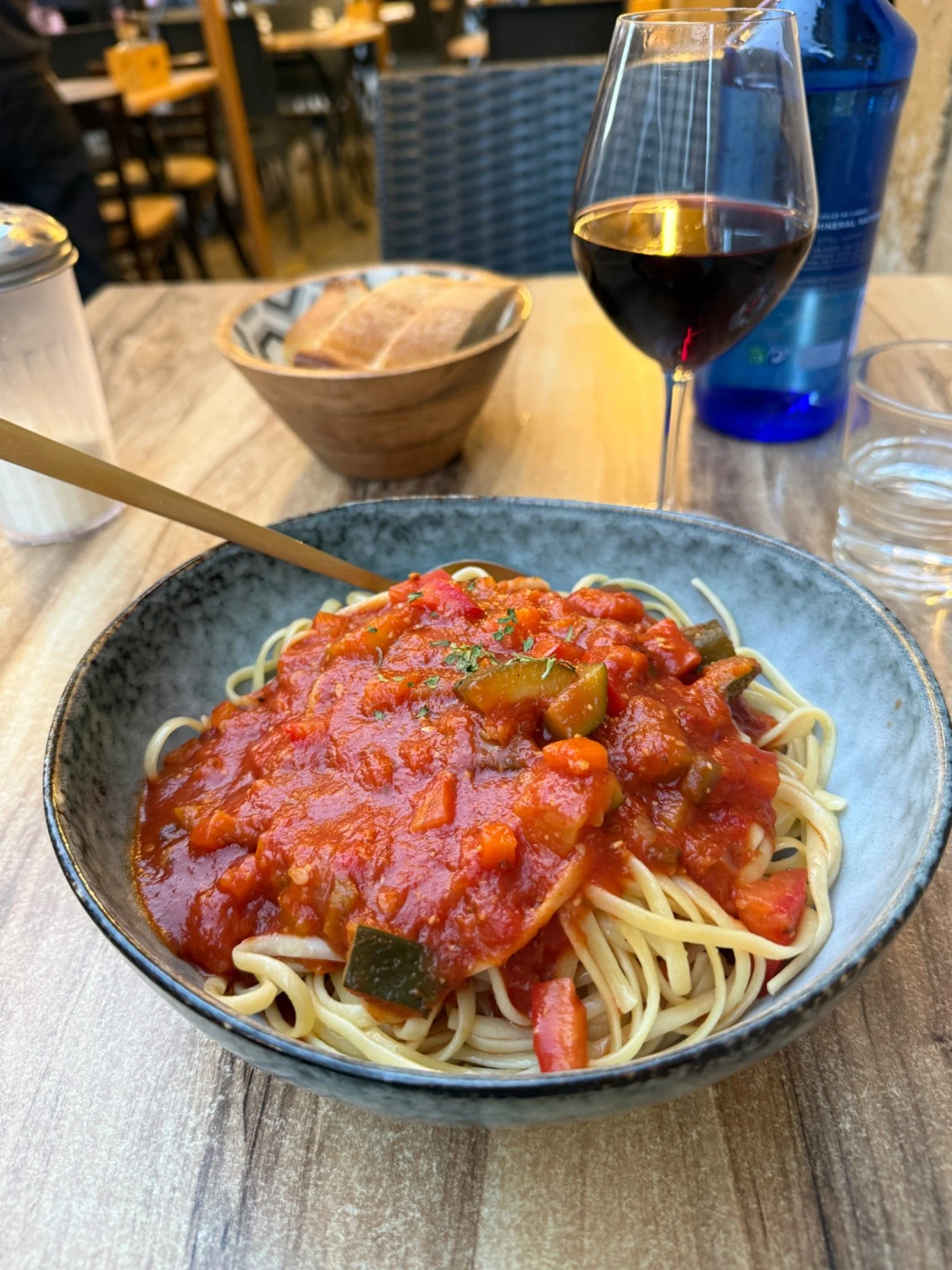
An ordinary lunch in Carcassonne: a small part of a different daily routine.
Walking as a Way of Thinking
There is, of course, a long association between walking and intellectual life.
From Aristotle to Rousseau and beyond, philosophers and writers have recognized that physical movement can encourage reflection. Modern research lends some support to this connection. A 2014 study by Stanford researchers Marily Oppezzo and Daniel Schwartz found that walking improved performance on certain measures of creative thinking.
But what I've discovered here goes beyond the relationship between movement and ideas.
Walking through Carcassonne changes what I notice.
On a recent walk through the Bastide, I stopped to photograph a green metal door.
It was beautiful, covered with elaborate ornamental ironwork. Someone had clearly devoted considerable thought and skill to its design and construction.
I began wondering about the person who made it. How many hours had gone into the work? What kind of training and craftsmanship had been required? What would it cost to commission something similar today?
I suspect the answer to that last question would be a considerable sum.
But what really interested me was the setting. This wasn't a museum piece, carefully exhibited for public admiration. It was simply a door on an ordinary street, part of the everyday architecture of the Bastide.
At some point, someone had decided that an entrance to a building should be not merely functional, but beautiful. And someone else had possessed the skill to make it so.
I found myself thinking about the values reflected in that decision. What did people consider worthy of ornamentation? How did earlier generations think about craftsmanship and the relationship between beauty and utility? How much human creativity and labor are embedded in the ordinary objects we pass without noticing?
I don't know when this particular door was made or who originally commissioned it. But it prompted me to think about the many ways that human ingenuity finds expression in the built environment, often in places we scarcely notice.
None of this was on my agenda that morning.
I hadn't set out to contemplate craftsmanship, economics, or changing attitudes toward beauty. I was simply walking down the street.
The door caught my attention, and my thoughts followed.
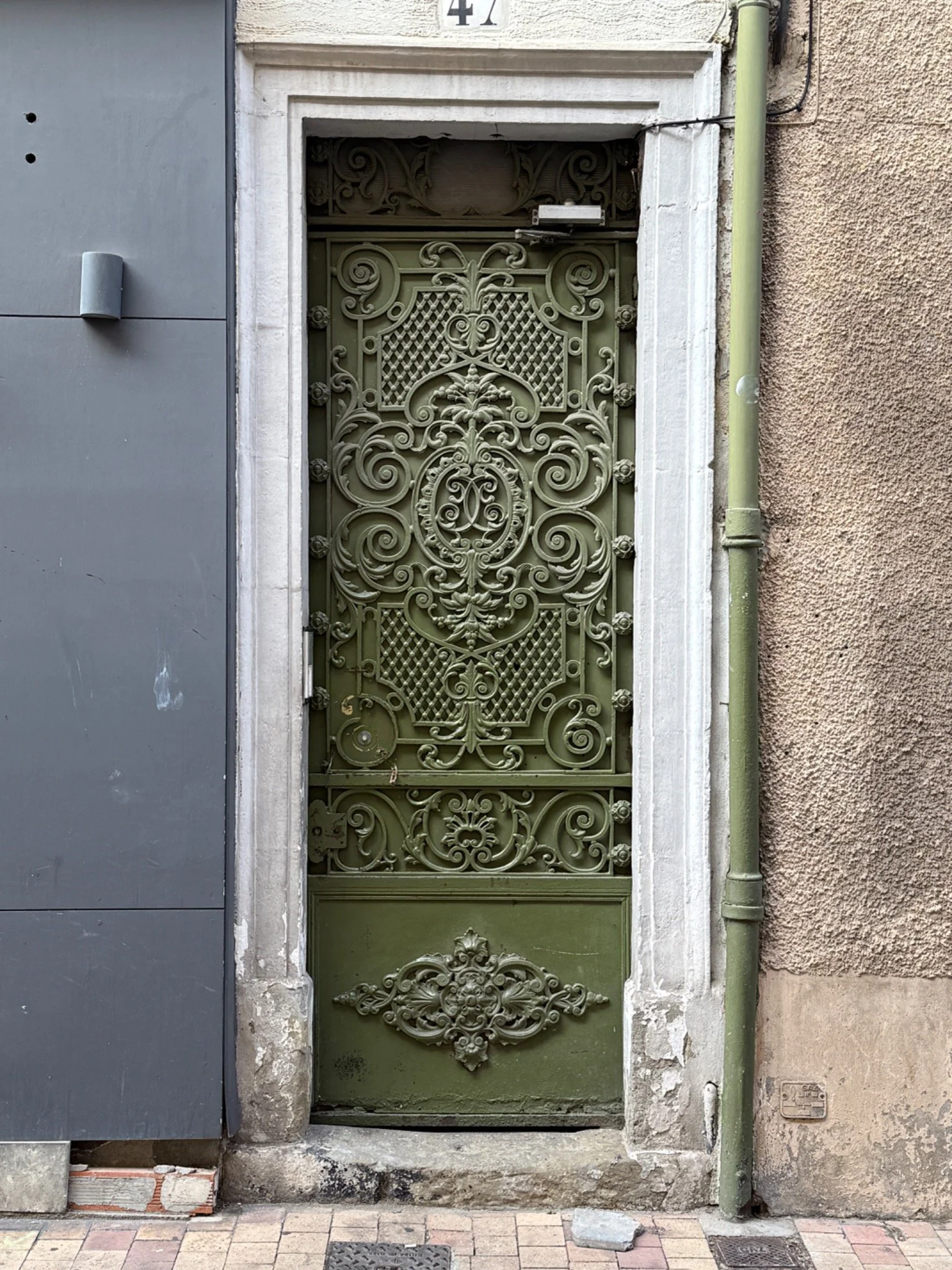
A doorway in the Bastide Saint-Louis that stopped me in my tracks—and started me thinking.
This happens frequently when I walk through Carcassonne.
I notice the proportions of an old building, the ornamentation of a façade, or the unexpected beauty of something that has stood quietly on the same street for generations.
I hear church bells marking the passage of time. They remind me that the day has a rhythm that exists independently of my appointments, deadlines, and electronic notifications.
And because I'm learning French, even an ordinary walk can become an intellectual exercise. I find myself constructing sentences in my head, working through questions of grammar, imagining how I might express a particular thought or navigate a conversation.
The language is no longer simply something I'm studying. It's part of the world I'm trying to inhabit.
I notice the people around me, too. The residents going about their daily business, the familiar faces at neighborhood cafés, the small interactions that give a place its particular character.
All of these experiences have something in common.
They direct my attention outward.
At home, I can become so absorbed in my own thoughts, obligations, and distractions that the external world sometimes recedes into the background. I move through familiar surroundings while mentally occupied with something else.
Here, I find myself more inclined to look, listen, and engage.
It's not that my concerns disappear. It's that they no longer occupy quite so much of my available attention.
The physical act of moving through an interesting environment gives me a way to step outside the confines of my own preoccupations.
And I find that this produces a kind of cognitive reset.
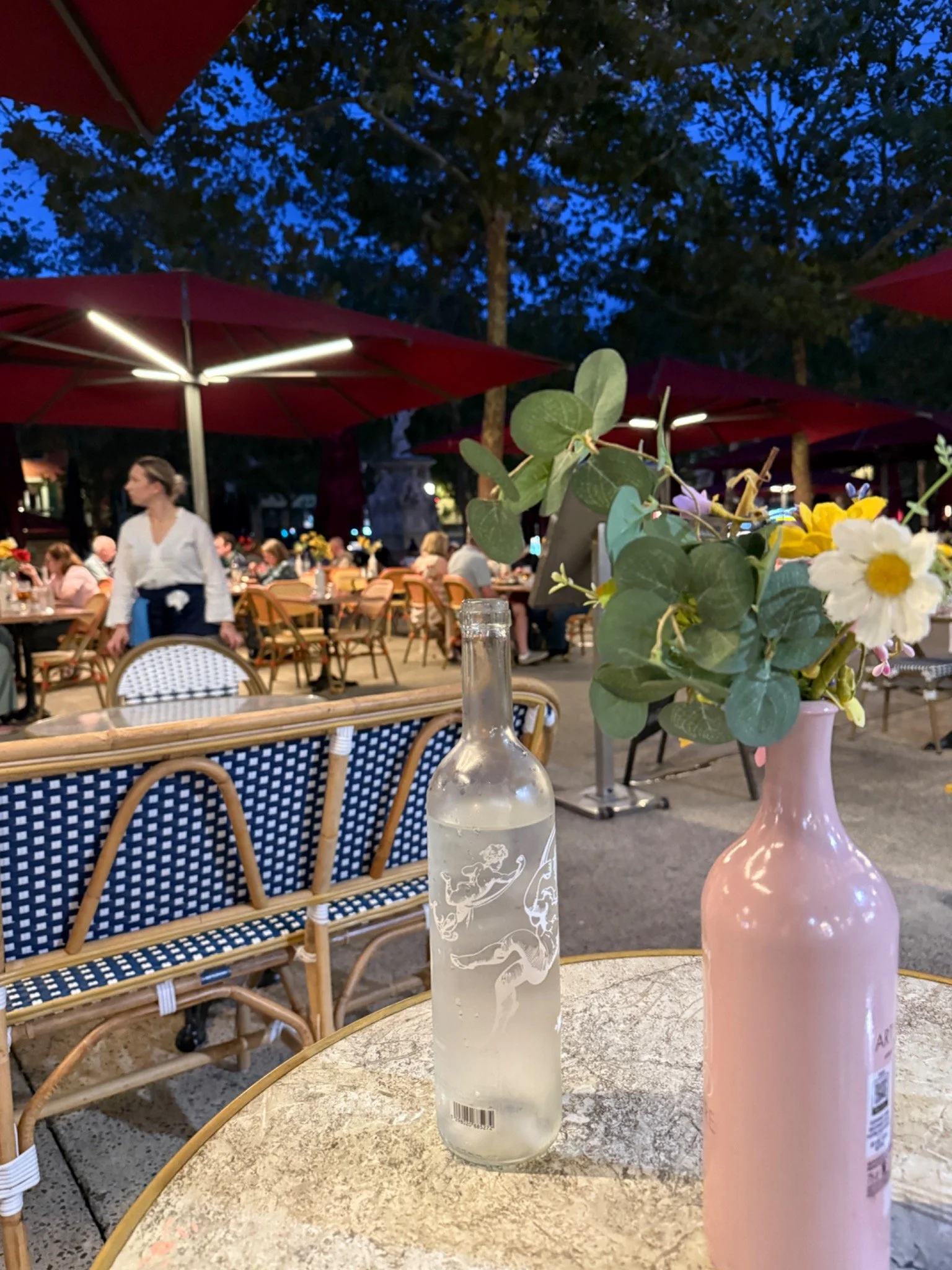
The cafés and public spaces of Carcassonne invite attention to everyday community life.
The Company of Previous Generations
Carcassonne also provides something that I find increasingly valuable: a tangible sense of connection to the past.
The medieval Cité is the most obvious expression of that history, but the Bastide has its own centuries-old story. These are places that have accommodated the ordinary lives of generations of people.
Walking their streets, I'm reminded that the activities occupying my own days are hardly new.
People have gone to market, met friends, raised families, worried about money, conducted business, fallen in love, and contemplated their futures in these surroundings for hundreds of years.
The details of their lives were different, of course, but many of their fundamental concerns were not.
I find something comforting in that continuity.
Modern professional life can create the impression that everything is immediate and urgent. We measure our days in deadlines, tasks, and accomplishments, often with little time to reflect on how those activities fit into the larger course of a life.
In Carcassonne, the built environment quietly challenges that sense of urgency.
A building that has stood for centuries offers a different perspective on the importance of today's anxieties.
The streets connect me not only to the people who live here now, but also to those who lived here long before me.
And that connection has a way of restoring a sense of proportion.
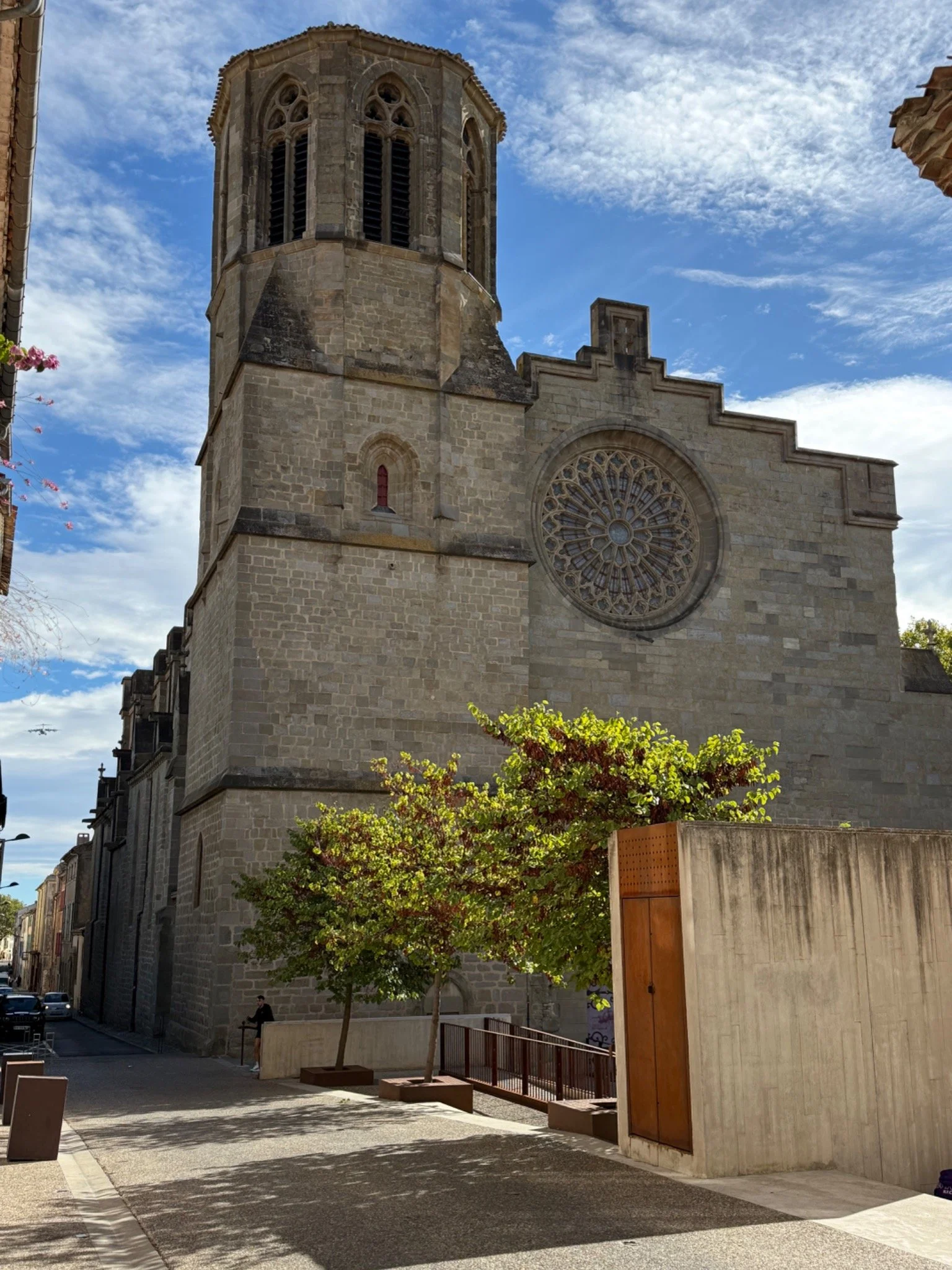
Historic architecture remains part of the setting for everyday life.
The Environment Is Part of the Equation
When I'm in the United States, I often feel more hurried, more distracted, and less physically healthy than I do here.
I don't attribute all of that to geography. Life at home comes with responsibilities and routines that are different from those of a stay in France. I'm aware that visiting a place and living there permanently are not the same experience.
Nor am I suggesting that life in France is free of stress or inconvenience.
But I do think the physical and social environment deserves more credit than we typically give it.
We tend to approach personal improvement as a matter of individual discipline. We resolve to eat better, exercise regularly, slow down, read more, be more creative, and pay closer attention to the world around us.
Then we return to surroundings that may make those aspirations difficult to sustain.
We treat the struggle as a failure of willpower when it may, at least in part, be a problem of design.
What if we paid more attention to the conditions under which our desired habits become natural?
What if, instead of continually asking ourselves to make better decisions, we considered how to arrange our lives so that fewer difficult decisions were necessary?
For me, Carcassonne offers an illuminating example.
The walkable streets make movement part of daily life. The food I encounter encourages me to eat differently. The architecture and history invite reflection. The church bells, the French language, and the people around me continually draw my attention toward the world beyond my own concerns.
And the cumulative effect is more significant than any one of those things alone.
I feel healthier, more curious, more engaged, and more connected to the community around me.
Perhaps this is an important part of what it means to reset one's life.
We spend so much time trying to change ourselves that we sometimes overlook the possibility that changing our surroundings might accomplish some of the work for us.
The question isn't simply what kind of person we want to become. It's what kind of environment makes that person possible.
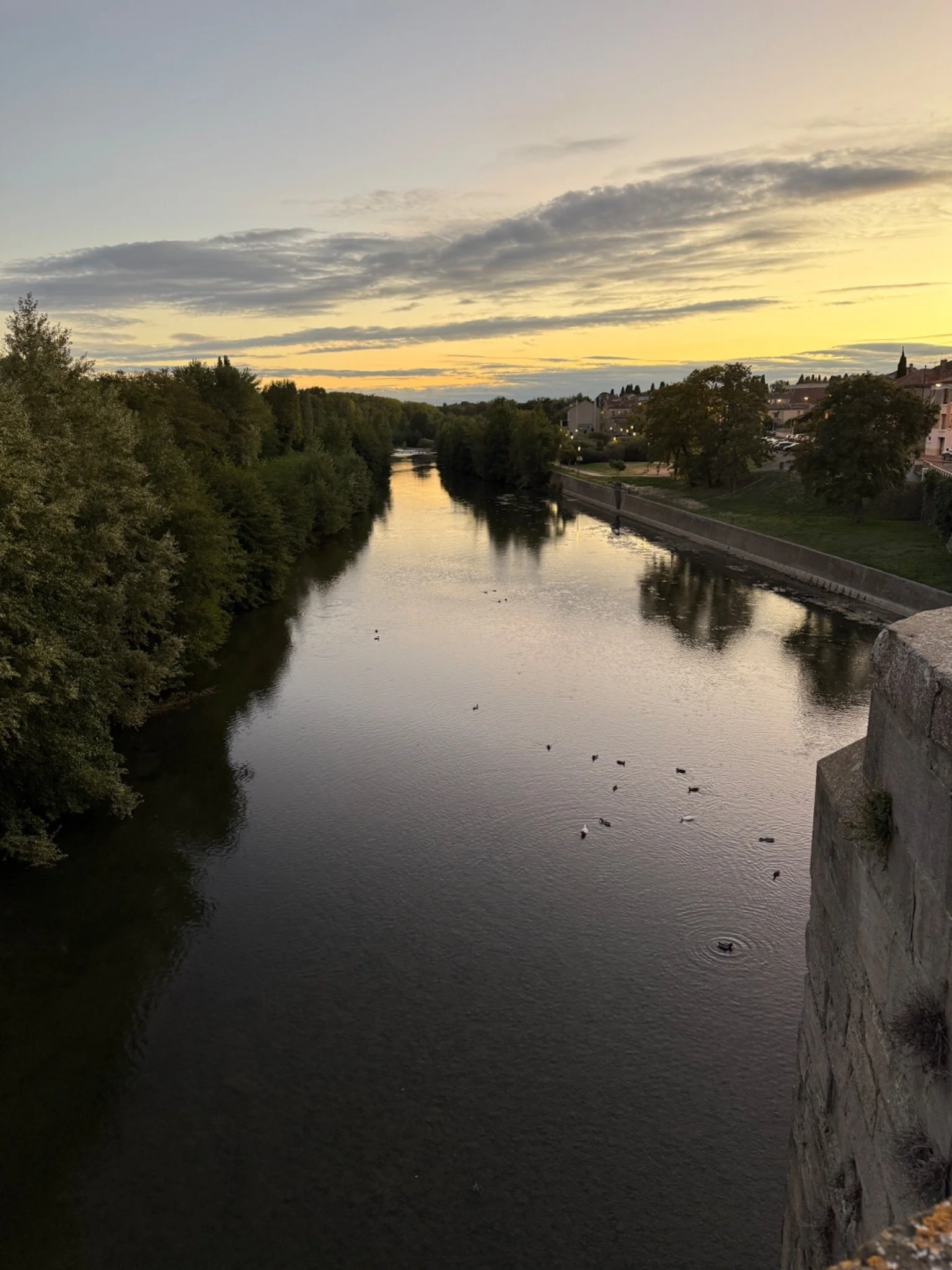
Nighttime at the Pont Vie